Self-Service Client Reporting Dashboard
OVERVIEW
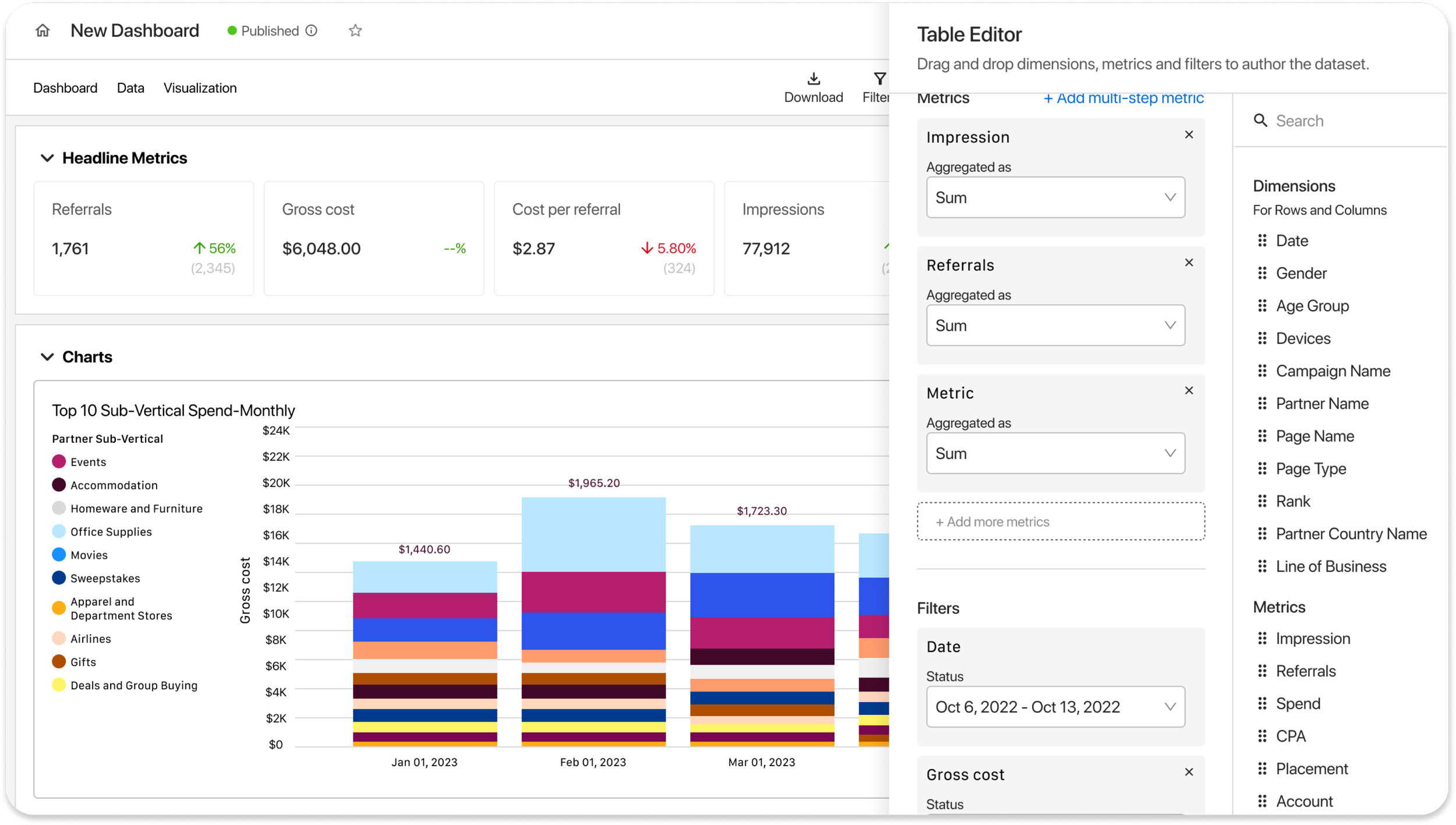
Designed a self-service reporting tool that gave Account Managers direct control to build and publish client-facing performance reports — replacing a manual workflow that stitched together three disconnected tools (raw platform data, Google Sheets for formatting, Tableau for visualization) and required analyst involvement for every client report. Before this, every client report required routing through internal resources, creating bottlenecks that slowed client relationship cycles. I led the design end to end, building it in phases and validating with a beta group of AMs over several months before company-wide rollout.
WHAT MADE IT MORE THAN A REPORTING TOOL
The surface-level ask was a reporting dashboard. The underlying problem was one of dependency and confidence — Account Managers didn't have the tools to do work that was fundamentally theirs to own, which meant internal analysts were constantly context-switching to handle requests that didn't require their expertise. The design challenge was building something flexible enough to serve varied client reporting needs while remaining simple enough that Account Managers with no analytics background could use it confidently and independently. Getting that balance right — powerful enough to replace the old workflow, approachable enough to eliminate the need for hand-holding — was the core design problem.
IMPACT
Achieved 85% user satisfaction with 90% of Account Managers finding the tool easy to use independently, with no analyst support required. Adoption extended beyond internal use — AMs began presenting the dashboard directly in client meetings, and client reception was strong enough that clients started asking for direct access themselves.
Following rollout, at least 10 AM-managed client accounts were granted access, a number that continued growing after I transitioned to another team. That external pull — clients actively requesting the tool rather than being asked to adopt it — was the clearest signal that the self-service model had solved a problem on both sides of the relationship, not just an internal one.